Get in touch
AI-Driven Digital Growth with Python explores machine learning, TensorFlow, deep learning, automation, SEO engineering, and scalable AI deployment systems.
Artificial Intelligence is no longer a research ambition — it is operational infrastructure.
Search engines rank with machine learning. Advertising platforms optimize with reinforcement systems. Recommendation engines predict user intent in milliseconds. Automation pipelines eliminate human bottlenecks. The digital economy is now algorithmic.
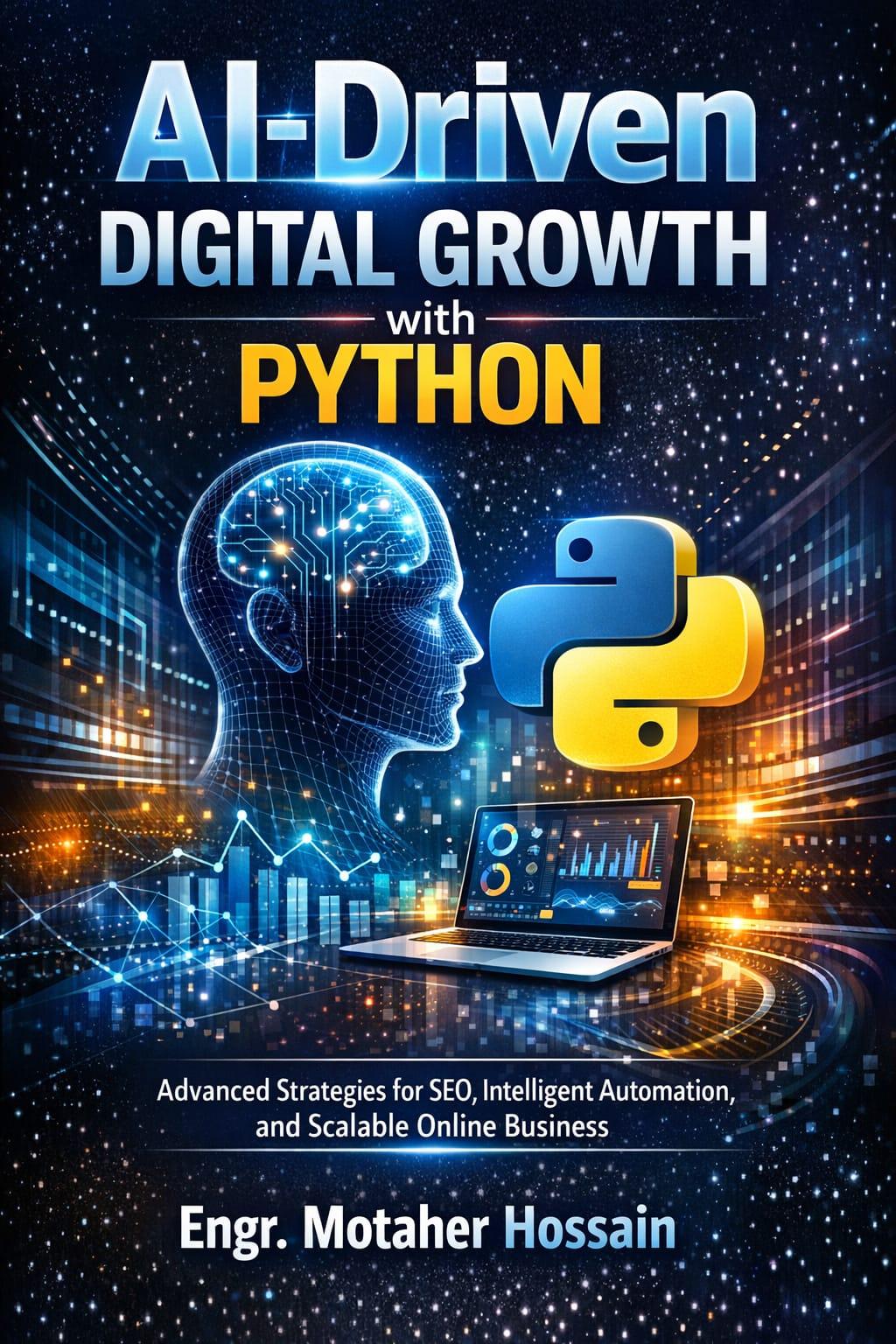
AI-Driven Digital Growth with Python: Advanced Strategies for SEO, Intelligent Automation, and Scalable Online Business by Engr. Motaher Hossain is not another introductory AI overview. It is a systems-level blueprint for professionals who want to architect intelligent digital ecosystems — not merely experiment with models.
This book treats AI not as theory, but as deployable digital infrastructure.
Many AI books stop at model training. This one begins deeper.
The early chapters build rigorous understanding around:
This is not superficial coverage. The goal is to ensure readers understand why models behave the way they do — not just how to call a library function.
Only after building mathematical stability does the book transition into applied engineering.
The middle architecture of the book shifts from theory to implementation using Python, TensorFlow, and Keras.
Instead of isolated notebook experiments, the focus is on building scalable AI systems:
This is engineering-grade knowledge — how models move from experimentation into containers, clusters, and production APIs.
The difference is critical:
Training a model is academic.
Deploying a reliable AI system is strategic.
Where many books avoid complexity, this one goes deeper into computer vision architectures that power real-world AI products:
These are not abstract examples — they represent the backbone of:
The book shows how these architectures integrate into scalable pipelines — from dataset preparation to inference optimization.
What distinguishes this work from standard machine learning textbooks is its integration with digital growth strategy.
Engr. Motaher Hossain brings a rare interdisciplinary perspective — merging:
Search engine optimization is no longer keyword stuffing — it is algorithmic understanding. Reinforcement learning optimizes bidding strategies. Deep learning models power search ranking signals. Similarity learning enhances content clustering.
AI is not separate from digital marketing — it defines it.
This book positions AI as a growth engine, not merely a research discipline.
Modern AI systems must scale horizontally. The book addresses this directly through:
Organizations that fail to build scalable AI infrastructure will struggle against algorithmically optimized competitors.
This book explains how to build systems that survive real traffic, real users, and real business pressure.
This is not written for passive learners.
It is written for:
If you want conceptual comfort, this book will challenge you.
If you want execution capability, it will equip you.
Engr. Motaher Hossain’s philosophy is direct:
Artificial Intelligence must power real businesses, automate decision-making, and build scalable digital ecosystems.
His engineering background combined with expertise in automation and SEO strategy shapes the book’s practical direction. It advocates professionals who can merge:
Because the future does not belong to isolated specialists — it belongs to integrated system builders.
We are in an era where:
Companies that treat AI as optional experimentation will be displaced by those who treat it as infrastructure.
This book delivers the roadmap to build that infrastructure.
AI-Driven Digital Growth with Python is not a tutorial collection.
It is a blueprint for building intelligent digital power.
From Bayesian foundations to distributed TensorFlow clusters, from CNN architectures to SEO-integrated automation systems, from reinforcement learning to Kubernetes deployment — the book connects mathematics, engineering, and digital growth into one unified framework.
It is written for builders.
And the next era belongs to builders.